
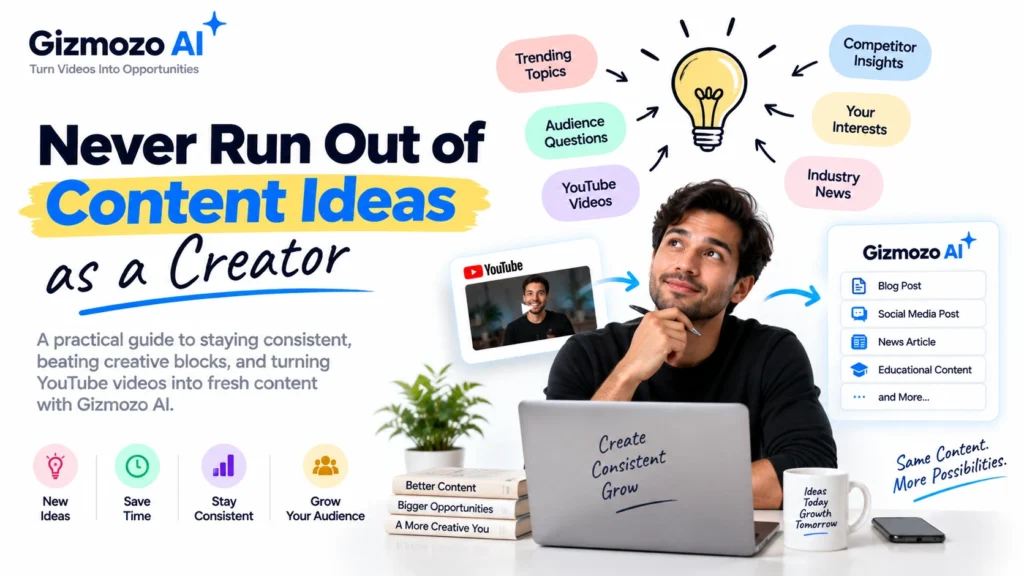
Running out of content ideas is not a creativity problem. It is a system problem. Every creator who has published consistently for more than six months has hit the same wall: the calendar slot is open, the audience expects something, and the idea that seemed so clear yesterday has evaporated. The creators who push through that wall are not more inspired than the ones who do not. They have a better system for finding and transforming content ideas before inspiration runs dry.
This guide covers that system: what actually keeps content flowing, where the best ideas already exist, and how Gizmozo AI solves the specific bottleneck that stops most creators from turning a good idea into published content.
Why Consistency Matters More Than Any Single Piece of Content
Most creators know consistency is important. Far fewer understand exactly why it works the way it does.
Algorithms across every major platform YouTube, Instagram, LinkedIn, Google reward accounts that publish predictably. Regular posting signals to the platform that your account is active and trustworthy enough to show to audiences. An account that posts brilliantly once a month and then goes quiet for three weeks loses algorithmic momentum every time it disappears. An account that publishes reliably even if each individual piece is not exceptional builds compounding reach over time.
The implication is uncomfortable but important: consistently published good content outperforms irregularly published great content. The audience builds. The algorithm learns. The growth compounds. This is why consistency is not just a discipline or habit; it is a strategic requirement for any creator who wants sustainable audience growth.
The problem is that maintaining consistency while also maintaining quality is genuinely hard. And it is hardest specifically at the idea stage. You can be an excellent writer or a skilled video producer and still find yourself staring at a blank content calendar, wondering what to say next.
Where Content Ideas Actually Come From (And Why Most Creators Exhaust Them)
The most common mistake creators make is treating their own mind as the primary source of content ideas. They sit down, try to think of something original, produce it, and repeat. This works for a while, usually until the obvious ideas are used up, and the less obvious ones require increasingly more mental effort to surface.
In practice, the best content ideas come from external sources that your audience is already engaging with:
What your audience is asking. The comments on your existing posts, the DMs you receive, the questions people ask in communities you belong to these are direct signals of what your audience wants explained or explored. A question asked once is a content idea. A question asked repeatedly is your next most important article or video.
What is trending in your niche? News, developments, product releases, cultural moments: content that connects your expertise to something people are already paying attention to earns faster traction than evergreen content because the timing creates urgency.
What other creators are covering. Not to copy, but to identify gaps. A topic covered superficially by ten different creators is an opportunity for the one creator who covers it properly.
What you are consuming. The podcasts you listen to, the videos you watch, the articles you read, the conversations you have these are all potential content ideas waiting to be transformed into your own format for your own audience.
The last source is the most powerful and the most underused. Most creators consume enormous amounts of content in their niche every week. Almost none of them have a reliable system for turning that consumption into published content. The idea crosses their mind “I should write something about this” and then disappears because the gap between having an idea and turning it into finished content is too wide to cross spontaneously.
The Gap Between Having an Idea and Having Content
This is the specific problem that most content strategy articles skip over.
You watched a YouTube video that covered your niche topic brilliantly. The ideas in it are exactly what your audience needs to hear. You want to create something based on it: your own perspective on the same subject, a written version for the readers in your audience who prefer articles, a social post that pulls the key insight.
But you cannot just republish the video. You need to transform it into your own format, and that transformation takes time and effort that you may not have today, this week, or before the content window closes.
This is the gap Gizmozo AI was built to close.
How Gizmozo AI Solves the Content Idea Bottleneck
Gizmozo AI is a content generation tool that does one thing no other AI writing tool does: it turns a YouTube video into original written content that has never existed anywhere on the internet before.
Every other AI writing tool ChatGPT, Jasper, Copy.ai generates content from its training data. That data is built from text already published on the web. When you ask these tools to write about a topic, they produce a synthesis of what people have already written about it. The output is derivative by design.
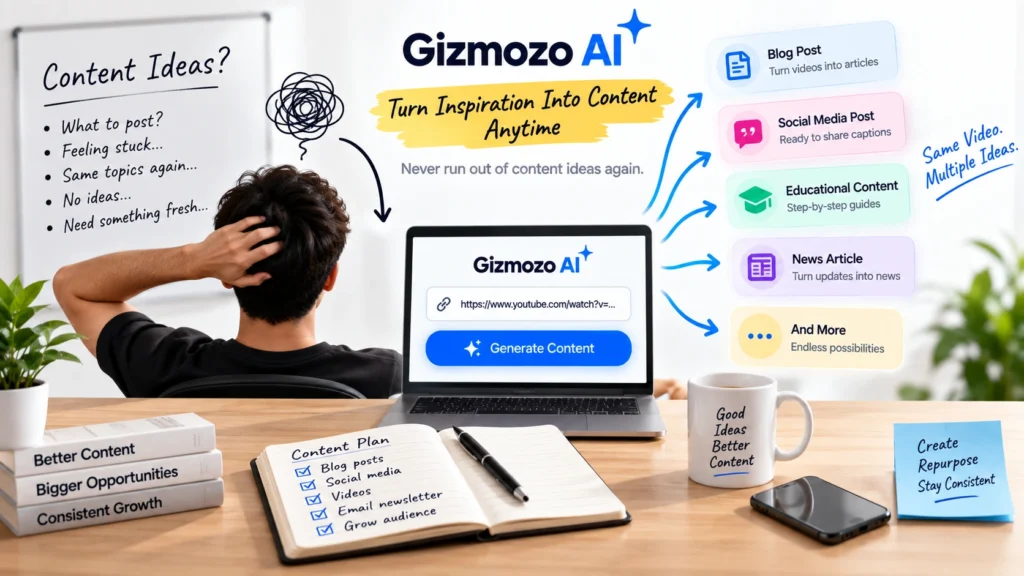
Gizmozo works from a different source. You paste a YouTube URL. Gizmozo extracts the spoken transcript of the video, the specific observations, examples, and analysis from a real person who actually engaged with the topic. It then transforms that transcript into a structured, publish-ready article in the format you choose: blog post, news article, educational content, or social media post.
The output reflects what was actually said in that specific video, not the average of what has been written about the topic across the internet. That makes it original. That makes it specific. And that specificity is what separates content that feels genuinely useful from content that feels like it could have been written by anyone about anything.
The non-obvious insight: When you use Gizmozo to transform a YouTube video into an article, you are not just saving writing time. You are adding content to the internet that did not previously exist in text form. The video’s knowledge was locked in an audio-visual format. Your published article makes it searchable, indexable, and discoverable for people who would never have found the original video. You are not recycling existing content; you are creating new content from a source that has never been published as text.
A Practical System for Never Running Out of Content Ideas
Here is the system that works in practice, built around Gizmozo as the transformation layer:
Step 1: Build a content source library
Identify five to ten YouTube channels in your niche that consistently publish high-quality, in-depth content. Subscribe to them. Set notifications. This is your ongoing content idea pipeline, not to copy, but to transform into your own format for your own audience.
Do the same for podcasts, newsletters, and communities where conversations about your niche happen. Every piece of content you consume is a potential idea you can develop.
Step 2: Capture ideas immediately
When you watch, read, or hear something that gives you a content idea, note the source URL immediately. A simple note in your phone, a browser bookmark folder, or a Notion database whatever you will actually use. The idea feels obvious in the moment and disappears within hours.
Step 3: Transform YouTube ideas with Gizmozo
When a YouTube video gives you a content idea:
- Copy the video URL
- Open gizmozoai.com and paste the URL
- Select your content format: Blog Post for articles, Social Media Post for captions, Educational Content for instructional pieces
- Review the generated output in around 30 to 60 seconds
- Add your own perspective, updated context, or editorial framing
- Publish
The transformation from “I watched a great video about this” to “I have a published article about this” collapses from hours to minutes.
Step 4: Maintain a publishing calendar
Decide on your publishing frequency before inspiration dictates it. Two blog posts per week, five social posts per week, one video per week whatever your capacity supports. Lock the calendar slots. Fill them from your idea library using Gizmozo for the YouTube sources. Your consistency becomes structural rather than motivational.
Step 5: Let performance data generate new ideas
The content that earns the most engagement, the most shares, or the most search traffic tells you what your audience most wants. After one month of consistent publishing, your analytics become your best content strategist, pointing you toward the topics and formats that earn the most return for your effort.
A Weekly Content Ideas Checklist for Creators
Use this every week to ensure your content calendar never runs empty:
- Review five YouTube videos from your source library; note any that could become articles
- Check audience comments and DMs for questions that recur; each is a content idea
- Identify one trending topic in your niche that connects to your expertise
- Paste the best YouTube source URL of the week into Gizmozo and generate a first draft
- Review and personalise the generated article before publishing
- Schedule the week’s content across your channels before the week begins
FAQ
The most reliable cure for creative block is external input rather than internal effort. Read articles in your niche, watch YouTube videos by creators you respect, scroll through the questions people are asking in communities related to your topic. Block is usually a symptom of trying to generate ideas from inside your own head when your best ideas come from engaging with external content and asking, “What do I think about this?” Gizmozo helps by giving you a direct path from consuming a YouTube video to having a published piece based on it, removing the production friction that turns ideas into procrastination.
Any publicly available YouTube video can be used as source material. Standard ethical practice applies: use the content to inform your own piece rather than presenting someone else’s observations as your own, and consider crediting the original video or embedding it in your published article. This transparency builds reader trust and often results in the original creator sharing your piece with their own audience.
Frequency requirements vary by platform, but the consistent finding across platforms is that regular, predictable publishing outperforms sporadic high-quality publishing over twelve months. For most blog-based content operations, two to three articles per week is sufficient to build meaningful organic traffic. For social media, daily posting is the norm for fast growth. The right frequency is the highest frequency you can maintain without compromising the review and editorial quality of each piece.
Gizmozo generates a strong, structured first draft in around 30 to 60 seconds. In most cases, the output is accurate and well-organised but benefits from a ten-to-fifteen-minute review pass checking factual claims, adding your own perspective, and optimising the title and meta description for your target keyword. Think of it as an editorial starting point rather than a finished product. The creative and analytical work of identifying which videos to use and what angle to take remains yours; Gizmozo handles the production work.
The Consistency Problem Has a Practical Solution
Every creator who has struggled with content ideas has felt the same frustration: you know what your audience needs, you know you need to keep showing up, and you keep running into the gap between knowing what to create and actually creating it.
Gizmozo closes that gap for YouTube-sourced content. The ideas are already in the videos you watch. The knowledge is already in the transcripts. What was missing was a tool fast enough and reliable enough to make the transformation worth doing every time an idea crossed your mind.
Try Gizmozo AI for free at gizmozoai.com: paste any YouTube URL and have a publish-ready piece of content in under a minute.