
If you are a YouTube content creator who wants a blog, you already have everything you need. The research, the structure, the knowledge, the value it is all inside the videos you have already made. What you have been missing is a fast, reliable way to get it out of video format and into written articles that your audience can read, search engines can index, and Google can rank.
Gizmozo AI solves that problem directly. Paste your YouTube URL, wait around 30 seconds, and receive a complete, structured blog post built from your video’s actual content not generic AI text about the same topic, but a written version of what you specifically said.
Why Every YouTube Content Creator Should Also Have a Blog
You put real effort into your videos. You research the topic, plan the structure, film it, edit it, and publish it. That effort produces content your viewers love. But a significant portion of the people who would benefit from your knowledge will never see your videos because they do not find information by scrolling YouTube. They search Google.
Think about who searches Google for topics in your niche. They are often people who want to learn something quickly, who prefer reading over watching, who are on a work computer where playing a video is awkward, or who found your channel through a search and want to learn more. These are real people with real interest in exactly what you cover. Without a blog, they cannot find you.
A blog does something your YouTube channel cannot do on its own: it creates permanent, searchable, indexable pages that appear in Google results for the keywords your audience uses. Every blog post you publish from a video gives you a second discovery path for that content, one that compounds over time rather than fading as the algorithm moves on.
The creators who build both channels grow faster, reach broader audiences, and earn more from their knowledge. The barrier has always been the time it takes to write. Gizmozo removes that barrier.
What Happens When You Do Not Have a Blog as a YouTuber
The consequences of being video-only are specific and measurable, even if they are invisible in your analytics.
Every week your videos go live without a companion blog post, you are missing the organic traffic those articles would have generated. A tutorial video that earns 15,000 YouTube views might have generated 40,000 blog page views over the following year if the content had been published as a searchable article because Google search drives sustained, compounding traffic in a way that YouTube recommendations do not.
There is also an authority problem. When readers search for topics in your niche and find articles from bloggers who are less knowledgeable than you, those bloggers build the domain authority, the backlinks, and the reader trust that should belong to you. Your knowledge is better. Their format is more discoverable.
A blog fixes both problems simultaneously.
How Gizmozo AI Turns Your YouTube Videos Into Blog Posts
Gizmozo is built specifically for YouTube content creators who want written content from their videos. The workflow is designed to be fast enough to use immediately after every video you publish.
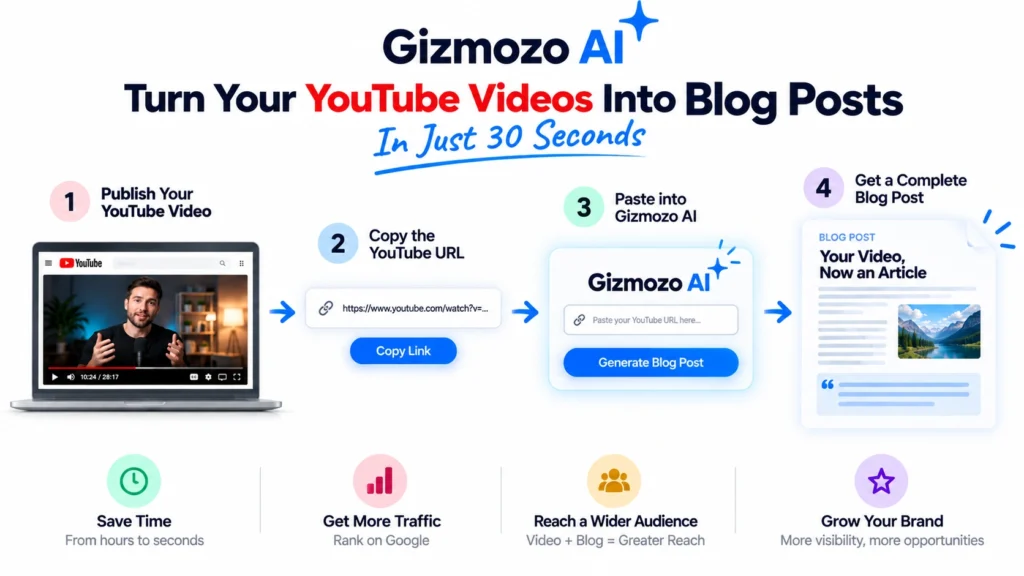
Step 1: Publish your YouTube video as normal
Nothing in your production workflow needs to change. Film, edit, and upload your video exactly as you always do. Once it is live on YouTube, you have everything Gizmozo needs.
Step 2: Copy the YouTube URL
Copy the full URL from your browser address bar or from YouTube’s share button. That single URL is the only input Gizmozo requires. No transcript export, no manual captioning, no file upload.
Step 3: Paste the URL into Gizmozo
Go to gizmozoai.com and paste your YouTube URL into the input field. Gizmozo immediately extracts the full transcript of your video, every word you spoke, accurately captured.
Step 4: Choose your content format
Select the format that best matches your video’s purpose:
- Blog Post for tutorial videos, opinion pieces, reviews, or general educational content. Produces a long-form article with a proper introduction, structured sections, and a conclusion.
- Educational Content for explainers, lesson-style videos, or any content designed to teach a concept progressively. Produces a learning-focused article that builds understanding step by step.
- News Article for commentary on recent events, announcements, or industry developments. Produces a journalistic-format piece with the most important information first.
- Social Media Post for a shareable caption based on the video’s strongest insight.
For most YouTube content creators, a blog post is the right choice for companion articles to your videos.
Step 5: Wait around 30 seconds
Gizmozo processes the transcript and generates a complete, structured article. The AI does not produce generic content about your topic; it generates from what you actually said in your video. Your specific examples, your specific framework, your specific perspective on the subject. The output is a written version of your content, not an AI approximation of the topic.
Step 6: Review, personalise, and publish
Read through the generated article. In most cases, it will be accurate and well-structured from the start. You can:
- Add a personal note at the top if you want to frame the article for your blog readers
- Include a screenshot or image from the video
- Embed the YouTube video in the post so readers can watch if they prefer
- Add internal links to related posts on your blog
- Check that your target keyword appears naturally in the title and first paragraph
Then publish. The entire process from finished video to published blog post takes under five minutes.
The SEO Advantage of Publishing Blog Posts Alongside Your Videos
Here is something most YouTubers do not realise until they start doing it: blog posts and YouTube videos are not competitors for your audience’s attention. They are complements that strengthen each other.
A blog post that embeds your YouTube video gives Google a rich, text-heavy page to index while also giving readers the option to watch. Google tends to rank pages higher when they contain both substantive written content and relevant embedded video because it signals that the page serves users in multiple ways.
Your YouTube channel benefits too. Readers who arrive at your blog post through a Google search and find your embedded video often become YouTube subscribers. The blog drives discovery that YouTube’s own algorithm may not provide.
The articles Gizmozo generates are built with Google’s E-E-A-T standards in mind, structured for readability, grounded in the actual content of your video (which is a genuine expertise signal), and formatted to serve the reader clearly. This is not generic AI content. It reflects your knowledge because it comes from your words.
What Kind of YouTube Videos Make the Best Blog Posts
Almost any substantive video translates well into a blog post. The best sources in practice are:
Tutorial and how-to videos: the step-by-step structure of a tutorial maps naturally into a numbered guide. Your on-screen instructions become written steps your readers can follow.
Educational explainer videos that break down a concept, topic, or skill become structured educational articles. These tend to rank well because they satisfy informational search intent precisely.
Review and comparison videos: your analysis of a product, tool, or experience becomes a structured review article with a clear verdict. Review content with genuine first-person experience is exactly what Google’s quality systems reward.
Commentary and opinion videos: your take on a development in your niche becomes an opinion piece that demonstrates your expertise and point of view. These articles attract backlinks and shares when they say something genuinely useful.
Q&A and community response videos answering questions your audience asked become an FAQ-style article that captures exactly the search queries your community uses.
Interview and guest video conversations with experts in your niche become interview articles. The subject’s insights and your questions create a natural interview structure that is highly readable.
A Real Example of Why This Matters
Consider two YouTube creators in the same niche. Both publish weekly videos of similar quality and depth. Creator A publishes only to YouTube. Creator B uses Gizmozo to publish a blog post alongside every video.
After one year, Creator A has 52 videos, and the organic search traffic that YouTube’s algorithm generates for them primarily comes from within the platform. Creator B has 52 videos and 52 indexed blog articles. Each article has been building search impressions, accumulating backlinks, and ranking for related keyword variations since it was published.
In most cases based on this pattern, Creator B’s total audience reach after one year is significantly larger because their content exists in two searchable ecosystems rather than one, and the written content continues to compound in search value long after each video stops receiving algorithmic push on YouTube.
The content was the same. The workflow took five additional minutes per week. The long-term outcome was meaningfully different.
A Weekly Publishing Checklist for YouTube Creators Using Gizmozo
Integrate this into your existing workflow. It adds under five minutes per video:
- Video published on YouTube
- YouTube URL copied from browser or share button
- URL pasted into Gizmozo gizmozoai.com
- Blog Post format selected
- Generated article reviewed for accuracy
- Video embedded in the blog post
- Meta title includes the video’s target keyword
- Article published to your blog on the same day as the video
- Blog post URL shared on your social channels
FAQ
No, but Gizmozo generates the article content, not the blog itself. If you do not have a blog yet, platforms like WordPress, Ghost, or Hashnode are straightforward to set up. Once your blog exists, Gizmozo gives you a new article to publish every time you upload a YouTube video.
In most cases, yes, when the articles are reviewed and meet standard quality criteria. Google’s ranking systems evaluate content based on whether it is useful, accurate, and well-structured. Articles generated by Gizmozo from your own YouTube videos reflect your genuine expertise and specific knowledge, which are exactly the signals Google’s quality guidelines reward. Generic AI content about a topic ranks poorly; content grounded in your real knowledge and perspective ranks well.
The generation process takes around 30 seconds in most cases. Your total time from finished video to published blog post, including pasting the URL, reviewing the output, adding an image, and clicking publish, is typically under five minutes.
Gizmozo automatically detects the language of your video transcript and generates the article in that same language. A video in Spanish produces a Spanish article. A video in Arabic produces an Arabic article. No language settings or translation steps are required.
Your Videos Deserve to Be Read, Not Just Watched
The content you create as a YouTube creator is valuable. Your tutorials help people learn skills. Your reviews help people make decisions. Your explainers make complex ideas accessible. That value should not be locked inside a video format that only reaches people who find it on YouTube.
A blog extends your reach to everyone who searches Google for the knowledge you already have. Gizmozo makes building that blog as fast as uploading the video.
Try Gizmozo AI free at gizmozoai.com: paste your first YouTube URL and have a complete blog post ready in under a minute.