
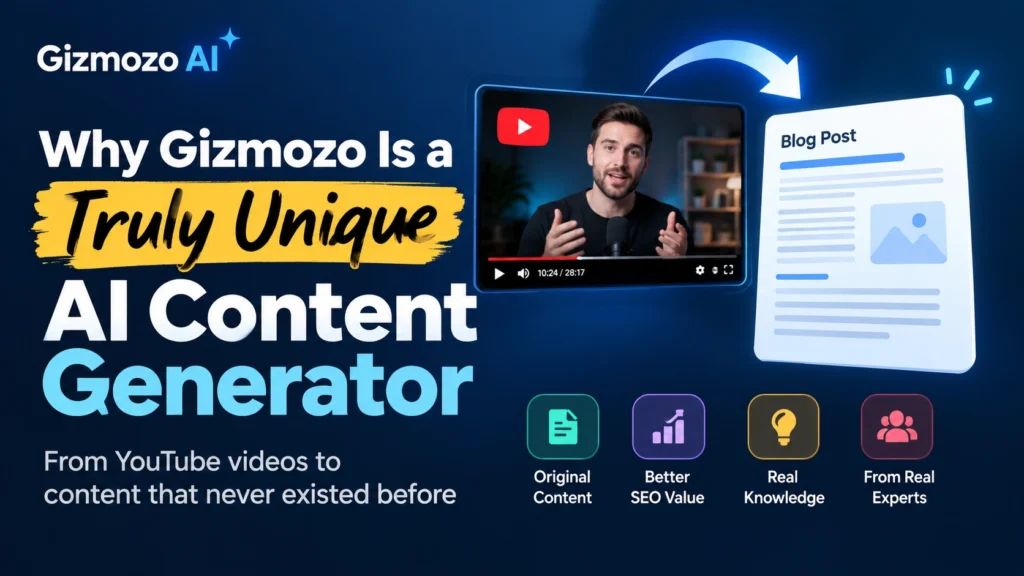
Gizmozo AI is a unique AI content generator because it does not source content from what already exists on the internet. Every other mainstream AI writing tool without exception generates content by recombining information it has already learned from published web pages, articles, and databases. Gizmozo AI works differently: it takes video content, extracts the spoken knowledge inside it, and transforms that into written content that has never existed anywhere on the web before.
That distinction is not a marketing angle. It is a fundamental difference in how the content originates. It has real consequences for the accuracy, originality, and SEO value of what gets published.
How Every Other AI Content Generator Works
To understand what makes Gizmozo AI different, it helps to be clear about how conventional AI content tools operate.
When you open Jasper, Copy.ai, ChatGPT, or any general-purpose AI writing tool and ask it to write a blog post about a topic, the model generates its output by drawing on patterns learned from text it was trained on. That training data is built from content that was already published on the internet: websites, articles, forum posts, academic papers, social media, and more.
The model does not know anything new. It knows what has already been written. When you ask it to write about a topic, it produces a synthesised version of what people have already said about that topic reorganised, paraphrased, and presented as new content.
This works adequately for some use cases. But it creates a structural problem that most users of these tools do not think about directly: every piece of content generated this way is, at its foundation, a recombination of existing published content. It is derivative by design. It is not adding new information to the internet it is redistributing what is already there.
What Gizmozo Does Differently
Gizmozo AI starts from a source that is not a web page. It starts from a YouTube video.
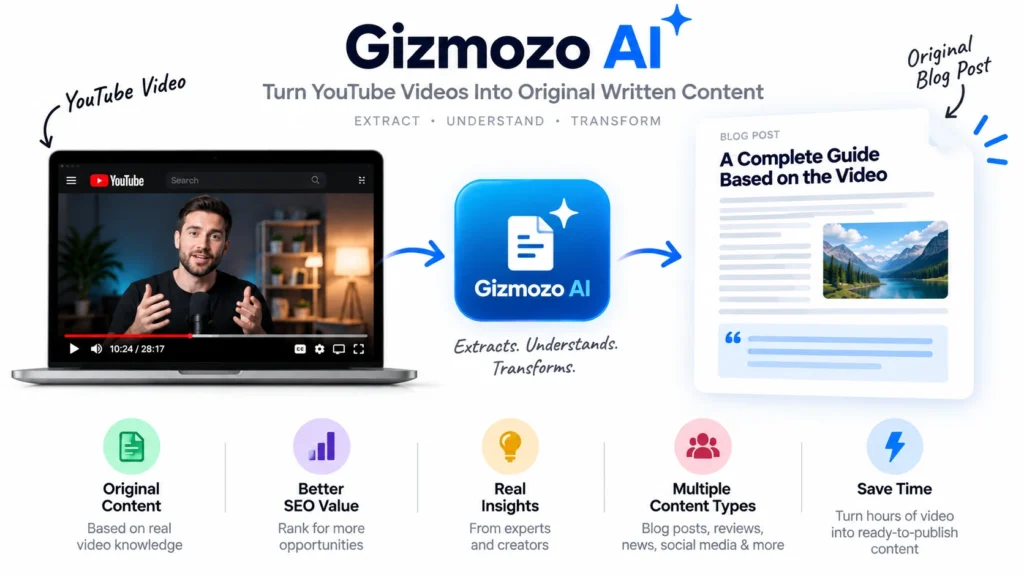
When you paste a YouTube URL into Gizmozo AI, the platform extracts the full spoken transcript of the video every word that was said by the presenter, reviewer, educator, journalist, or expert in that recording. That transcript represents knowledge, analysis, and perspective that was never published in text form anywhere on the internet. It existed as audio-visual content only.
Gizmozo AI then transforms that transcript into a structured written article a blog post, a news article, an educational guide, or a social media post depending on the format you select.
The result is written content that did not exist before. Not a restatement of what websites already say about the topic. Not a synthesis of existing published opinions. A transformation of spoken knowledge from a specific person, with a specific perspective, based on their specific experience into readable, indexable, publishable text.
That is the core of what makes Gizmozo AI a genuinely unique AI content generator: you are not telling the AI to collect information from what is already sitting on the internet. You are telling the AI here is a video that contains knowledge, turn this into meaningful written content. You are feeding the internet with content it did not previously have.
Why This Matters for the Content You Publish
The implications of this difference are practical and significant.
Originality that search engines can actually reward
Google’s quality systems in 2026 are increasingly good at identifying content that adds nothing new to what is already indexed. Thin rewrites of existing articles, generic AI summaries of popular topics, and content that simply paraphrases what other pages already say are penalised not because they are AI-generated, but because they are not original.
Content generated by Gizmozo AI from a YouTube transcript is structurally different. It is based on spoken content that has not been published in text form. The specific observations, examples, and analysis from the video do not exist anywhere as indexed text. When that content is published as an article, it is genuinely new to Google’s index not a repackaging of existing content.
This is why websites using Gizmozo AI to repurpose YouTube content can rank for keywords that are already served by established articles. The content is not competing on the same terms it is adding something different.
Accuracy grounded in a specific source
When a general AI tool writes about a topic, it produces the consensus view what most sources say, averaged together. When Gizmozo AI generates from a specific video transcript, it produces what that specific person actually said their exact observations, their specific examples, their personal assessment.
For review content, this means the article reflects what a reviewer genuinely experienced watching a film, not what AI predicts a review of that film should sound like. For tutorial content, it means the article reflects the specific steps a practitioner actually uses, not the generic steps that appear across dozens of existing guides.
This specificity is what makes the content useful and trustworthy rather than generic and interchangeable.
A sustainable content advantage
Most content operations hit the same wall eventually: they run out of genuinely new things to say about their topics because all their AI tools are drawing from the same pool of existing content. The more content is generated this way, the more the internet fills with slight variations of the same information.
Gizmozo AI sidesteps this problem because its source material YouTube video content is continuously expanding. Thousands of hours of new video are published every day from experts, practitioners, reviewers, educators, and commentators in every imaginable field. Every one of those videos represents potential article content that does not yet exist as text.
For a content operation built around Gizmozo’s workflow, the supply of original source material is essentially unlimited.
A Practical Example of Why This Matters
Consider a technology review blog covering a new smartphone release.
A writer using ChatGPT or any general AI tool asks for a review of the phone. The model generates from what it has learned about the phone specs from press releases, early coverage from tech publications, and aggregated opinion from review sites. The output is accurate but indistinguishable from dozens of other AI-generated summaries of the same published information.
A writer using Gizmozo AI finds a YouTube reviewer who spent two weeks with the phone as a daily driver. That reviewer recorded a 20-minute breakdown covering battery life in real-world conditions, camera performance in specific lighting situations, and specific software quirks they encountered after prolonged use. None of that was in any press release. None of it exists on any review website.
Gizmozo AI transforms that transcript into a structured review article. The published piece reflects the reviewer’s specific real-world observations not the aggregated average of press coverage. That article contains information Google has not seen before in text form, from a source that had genuine hands-on experience with the product.
The difference in content value is not subtle.
How to Use Gizmozo as Your Daily Content Generation Tool
The workflow is designed to be fast enough to use every day.
- Find a YouTube video covering a topic your audience cares about your own videos, expert creators in your niche, event coverage, review content, educational breakdowns
- Copy the YouTube URL nothing else is required as input
- Paste it into Gizmozo AI and select your content format: Blog Post, News Article, Educational Content, or Social Media Post
- Review the generated output for factual accuracy, add your own editorial perspective where appropriate, and optimise for your target keyword
- Publish
The generation step takes under 60 seconds. The editorial review typically takes 10 to 20 minutes depending on the complexity of the source video. For a daily content operation, this makes consistent high-quality publishing genuinely achievable without a large writing team.
Daily workflow checklist:
- Identify 1–3 YouTube videos relevant to your niche from the past 24–48 hours
- Paste each URL into Gizmozo AI and select the appropriate content format
- Review each output for accuracy check names, figures, and specific claims
- Add one paragraph of original editorial commentary per article
- Optimise the meta title and meta description for the target keyword
- Publish and share across your distribution channels
What Gizmozo AI Does Not Do (And Why That Matters Too)
Being clear about limitations is part of what makes any tool trustworthy.
Gizmozo AI does not replace editorial judgment. The AI transforms the transcript it does not decide which videos are worth covering, verify the credibility of the source, or guarantee factual accuracy beyond what the transcript contains. If a YouTube presenter states something incorrectly, the generated article may reflect that inaccuracy. Review passes are not optional.
Gizmozo AI does not generate content from sources other than YouTube. If you want to generate content from a podcast, an uploaded audio file, or your own notes, that is not what this tool does. Its specificity YouTube video as the only input is part of what makes the workflow clean and the output consistent.
Gizmozo AI does not publish content automatically. Every generated piece goes to a dashboard for the creator to review, edit, and publish manually. The AI handles the transformation. The creator handles the judgment.
FAQ
The fundamental difference is the source. ChatGPT and Jasper generate content by recombining information from their training data which is built from existing published web content. Gizmozo generates content from YouTube video transcripts spoken knowledge that has not previously been published as text. This means Gizmozo AI produces genuinely original written content rather than a restatement of what is already indexed on the internet.
In most cases, yes when the generated content is reviewed, edited, and published as a substantive article. Google evaluates content on the basis of quality, accuracy, and usefulness, not on how it was produced. Content generated by Gizmozo AI from a detailed YouTube transcript is grounded in specific, original source material, which gives it a stronger originality signal than content generated from general AI training data.
Transforming a YouTube transcript into an original article is similar to any other form of secondary journalism or analysis summarising, synthesising, and presenting information from a source in a new format. Standard journalistic practice applies: represent the source accurately, do not claim the original creator’s work as your own, and consider crediting or linking to the original video. Using third-party content as a source for original writing is a long-established practice in media.
Gizmozo AI automatically detects the language of the YouTube transcript and generates the output in the same language. A Spanish-language video produces a Spanish-language article. No manual language selection or configuration is required. This makes Gizmozo AI equally useful for English-language and non-English-language content operations.
The Content the Internet Has Not Read Yet
Every YouTube video published by an expert, a practitioner, a reviewer, or an educator contains knowledge that the internet cannot search, index, or discover because it exists only as video. Gizmozo AI exists to change that.
Not by recycling what is already online. By transforming what has never been text into content that can be found, read, shared, and ranked.
If you want to build a content operation on genuinely original source material rather than AI-generated derivatives of existing articles, Gizmozo is the tool built for that workflow.
Try it free at gizmozo.com no credit card required.